Carbon Credits from Waste Management Projects
A deep dive into waste management projects that avoid carbon footprint, create circular value, and generate carbon credits.
Methods of Generating Carbon Credits Through Waste Handling & Disposal
Bhuguard transforms waste streams into measurable climate value through organic waste management, recycling, waste-to-energy solutions, and landfill methane capture systems.
Composting & Organic Waste Management
Bhuguard enables aerobic and biological waste processing systems that prevent methane emissions from landfill disposal while enhancing nutrient recovery and supporting climate-positive waste management outcomes.
- Aerobic composting reduces methane by keeping decomposition in oxygen-rich conditions.
- Vermicomposting accelerates breakdown and improves nutrient recycling through biological processing.
- Organic waste is transformed into a valuable output that supports soil and circular systems.
- These systems create avoided emissions and strengthen measurable environmental impact.
Aerobic
Controlled oxygen-rich decomposition pathwayOrganic
Food, biomass, and biodegradable waste streamsMethane Avoidance
Reduces anaerobic landfill emissions riskSoil Value
Creates nutrient-rich circular outputTurning Waste Into Value
Plastics make up a substantial share of global waste, with over 300 million tonnes produced annually according to UNEP, and more than half of that discarded after a single use. These materials do not biodegrade, and when burned, they release greenhouse gases and toxic chemicals.
However, plastics also represent an untapped opportunity. When properly collected and recycled in material form, they can be transformed from pollutants into valuable raw materials while reducing emissions and diverting plastics from incinerators and landfills.
Advanced recycling systems offer scalable climate solutions. Through mechanical recycling and chemical recycling, waste is turned into new products, reducing environmental impact and supporting the circular economy.
Waste Management Project Typologies
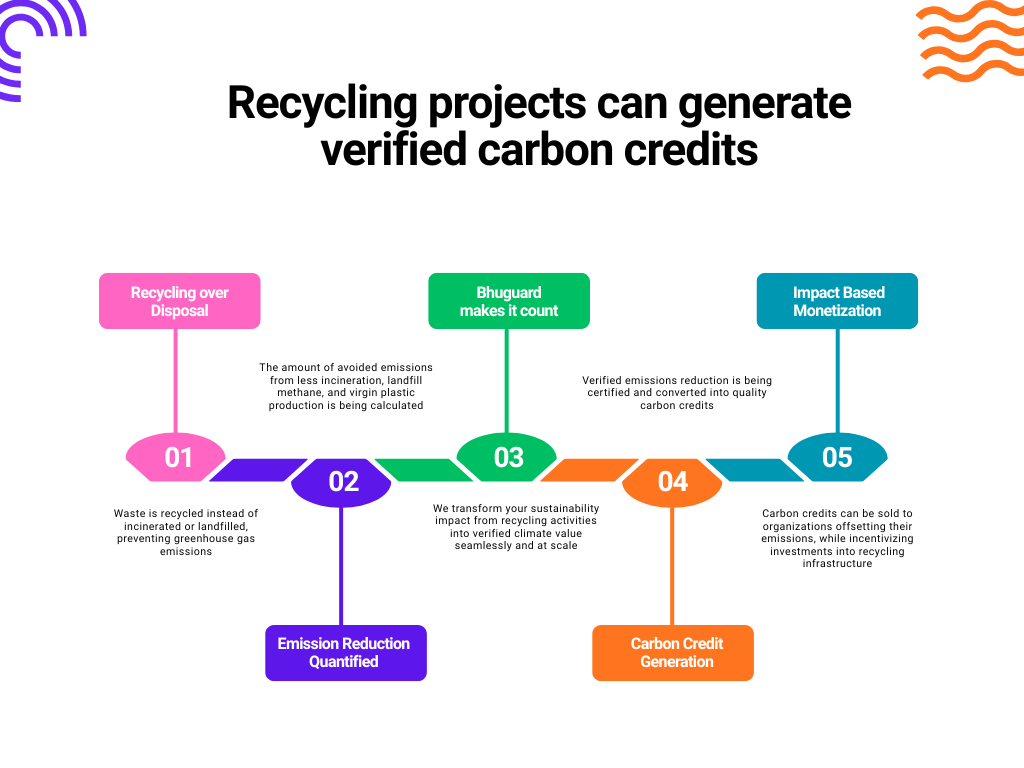
Two major carbon crediting pathways in waste management are recycling projects and methane recovery or avoidance projects. Both reduce emissions, create environmental value, and support local livelihoods.

Recycling Projects
The recycling, recovery, and reuse of plastics, metals, and paper help reduce the amount of waste sent to landfills and therefore lower CO₂ emissions. By working with recycled material instead of virgin inputs, the energy required is reduced, while the environmental pressure from natural resource extraction is also lowered.
Projects that introduce circular business models and innovative technologies create new employment opportunities for local communities. This typology takes materials that are often left untreated, unrecycled, and abandoned in landfill and transforms them into positive climate recovery solutions.

Methane Recovery & Avoidance Projects
Methane recovery projects capture landfill gas and turn it into electricity for local communities or directly into the national grid. This helps avoid CO₂ and methane emissions, improve safety, and improve livelihoods as surrounding communities experience cleaner air and less odor pollution.
These projects are often found in regions where agriculture shapes the landscape and local economy. Additional benefits include income generation, on-the-job training, and specialized knowledge transfer linked to renewable energy production.
Sustainable Development Goals